People are told constantly that you cannot have hardwood floors in Florida. That is not true, but the version of it that is true matters: you cannot install hardwood in Florida the way you would in Ohio and expect it to behave.
Get the choices right and wood works beautifully here. Get them wrong and you get cupping, gaps, and a floor that fights the climate every summer. Here is how to do it properly.
The two Florida realities
Humidity. Wood absorbs and releases moisture from the air around it, expanding and contracting as it does. Tampa Bay is humid for most of the year, and the swing between a humid August and a drier, air-conditioned stretch is enough to move wood noticeably.
Slab foundations. The great majority of Florida homes sit on a concrete slab rather than over a crawl space or basement. Concrete passes moisture vapor upward from the ground continuously, and it does so even when the slab appears completely dry. Solid hardwood installed directly over a slab reacts badly to that over time.
Between them, these two facts determine almost every hardwood decision in a Tampa Bay home.
Why engineered is usually the answer here
Engineered hardwood gets misunderstood. People hear the word and assume it is a lookalike product. It is not. The surface you walk on is genuine hardwood, real oak or hickory or whatever species you chose. What is engineered is the core beneath it.
That core is built from layers with the grain running perpendicular between them. Cross-lamination is what stops the board from moving across its width the way a solid plank does. The wood on top is real; the stability underneath is engineered.
In practice that means engineered handles Florida humidity swings far better, and it can be installed over a slab, glued down or floated. For most Tampa Bay homes it is not a compromise, it is simply the correct way to get real wood.
The one spec that matters most is wear layer thickness, the depth of real hardwood on top. A thick wear layer can be sanded and refinished once or twice, which means the floor can be brought back decades from now. A thin one cannot be sanded at all. Ask for that number before anything else, because a wood floor that can never be refinished is a different value proposition and you should know it going in.
When solid hardwood still works
Solid is not off the table entirely. If your home has a wood subfloor above grade rather than a slab, and you are prepared to keep indoor humidity reasonably stable, solid hardwood can absolutely work in Tampa Bay and it carries the advantage of being refinishable many times over a very long life.
The requirements are real though: proper acclimation inside the conditioned house before installation, correct expansion gaps at the perimeter, and consistent climate control afterward.
Running the AC is part of floor maintenance
This is the piece homeowners do not expect. Air conditioning dehumidifies as it cools, and stable indoor humidity is the single most effective thing you can do for a wood floor in this climate.
The homes where we see the worst humidity damage are the ones left unconditioned for long stretches, which in Tampa Bay often means seasonal properties and rentals sitting empty through the summer. A house closed up and unconditioned through a Florida August subjects its floors to conditions no occupied home experiences. If a property sits empty, keeping some baseline conditioning is far cheaper than dealing with the floor afterward.
Cupping, and what it tells you
Cupping is when board edges sit higher than the centers, giving the floor a subtle washboard feel underfoot. It happens because the underside of each board took on more moisture than the finished top, so the bottom swelled and pushed the edges up.
It is a moisture message, and the useful thing is to work out where the moisture came from: slab vapor coming through without an adequate barrier, indoor humidity running high, or an actual leak. Fixing the floor without finding the source just means doing it again.
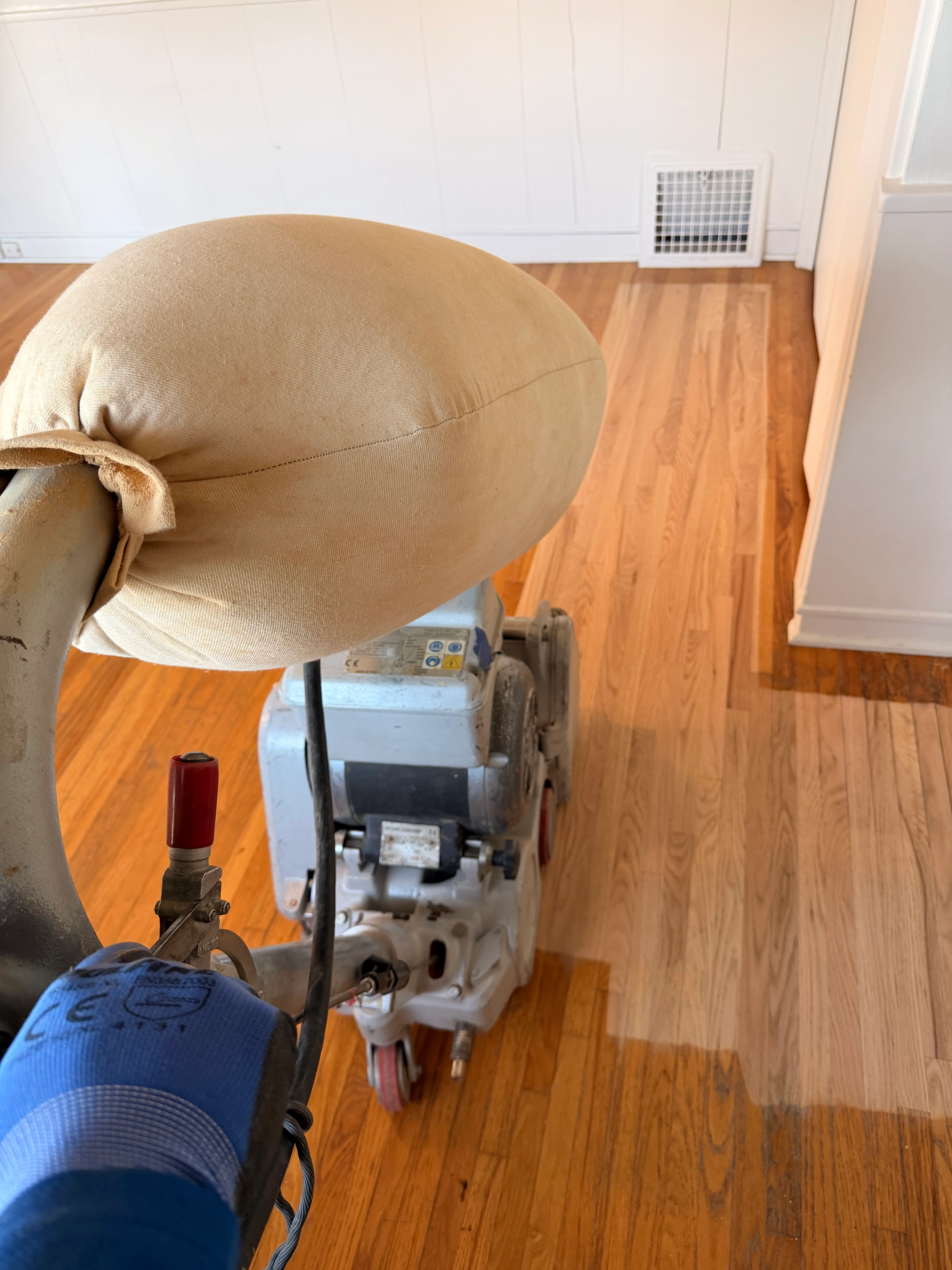
Critically, a cupped floor should never be sanded until it has fully dried and flattened out, which takes weeks. Sanding a still-swollen floor removes the temporarily raised edges, and when the boards later flatten they end up crowned, which is permanent and much harder to fix than the cupping you started with.
Species and finish for a Florida house
Oak remains the sensible default, hard and widely available with grain that hides wear well. Hickory is harder still and suits busy households. Whatever species, a matte or low-sheen finish hides Florida realities better than high gloss, which shows every bit of sand tracked in from the beach.
Sand is the underrated enemy here. It is abrasive, it comes in on everyone's feet, and it does more to wear a finish than foot traffic alone ever would. Entry mats do genuine work.
If wood is not going to work in a room
Kitchens, bathrooms, laundry rooms, and lanais are all rooms where we would generally point you somewhere else. Running hardwood through the living areas and a waterproof product through the wet rooms is a sensible specification rather than a compromise, and our guide to flooring for Florida humidity covers the whole-house picture.
We install hardwood flooring across Tampa Bay. Get a free estimate and we will look at your slab, your subfloor and how the house is conditioned before recommending anything.