People call us about cracked tiles. Very rarely is the tile the problem.
Tile is the most rigid floor covering there is. That rigidity is why it lasts decades when it is installed over something stable, and why it fails quickly when it is not. Everything that goes wrong with a tile floor goes wrong underneath it.
Deflection: the number that decides everything
Deflection is how much a floor bends under load between its supports. Every wood-framed floor deflects a little. Tile can accept very little.
The important thing to understand is that a floor can feel completely solid underfoot and still deflect more than a tile assembly tolerates. Human feet are not sensitive enough to judge this, which is why it is assessed by looking at the joist span, spacing and subfloor thickness rather than by walking across the room.
Where a floor is under-stiff, the fix is structural — additional subfloor thickness, or work at the joists themselves. An uncoupling membrane manages small movement well and is not a substitute for a floor that genuinely bends.
How Florida gets moisture into a subfloor
The two sources we find most often are both invisible until they are not.
Slow appliance leaks. A dishwasher seal or a refrigerator line that weeps a small amount each cycle. The water goes into the subfloor behind the appliance, where nobody looks, for months or years.
Failed shower waterproofing. Older showers were frequently built without the membrane systems used now, and once water is getting past the tile it goes into the framing. By the time it shows on the ceiling below or as a soft spot at the shower threshold, it has been happening a long time. Our piece on what actually makes a shower waterproof covers how that layer works.
Our humidity does not cause this on its own, but it does mean a wet subfloor dries far more slowly than it would in a drier climate, which extends how long the damage has to develop.
What we look for before quoting tile
- Deflection, from the joist span, spacing and existing subfloor thickness.
- Flatness, measured rather than eyeballed, because large tiles need much flatter than small ones.
- Soft spots or movement that indicate previous water damage.
- On slab, moisture readings and any existing cracking.
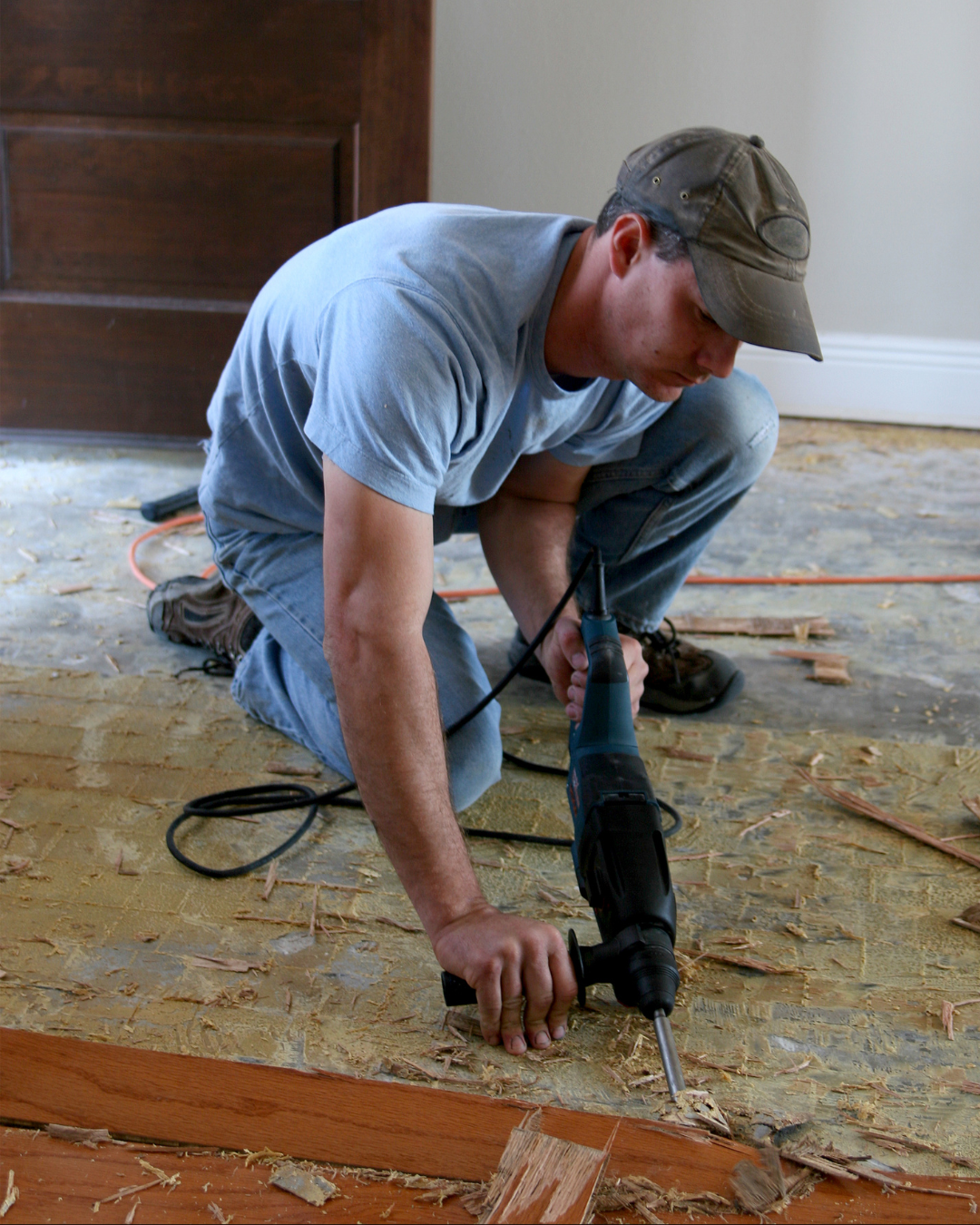
- Whether previous layers of flooring left residue that stops a proper bond.
Cracks in a concrete slab
A lot of Tampa Bay homes are on slab, which removes the deflection question and introduces a different one.
Slabs crack. Most of it is normal shrinkage and is not a structural concern, but a crack that continues to move will telegraph straight up through a tile floor bonded to it. That is what a crack-isolation membrane is for — it lets the slab move underneath without carrying that movement into the tile.
Identifying which cracks need isolating is part of the assessment, and it is far cheaper than discovering it as a line of cracked tiles across a new floor.
The honest cost conversation
Subfloor work is the least satisfying money anyone spends on a house. It is invisible, it delays the part you actually wanted, and it is easy to talk yourself out of.
It is also the entire reason one tile floor lasts twenty years and an identical-looking one fails in three. When we quote subfloor preparation as a separate line, it is so you can see what it is rather than have it buried — and so you can compare our quote honestly against one that has left it out.
If your existing tile is already cracking, we would rather find out why before replacing it. Book a free assessment and we will tell you what is actually moving.