Sheet vinyl does not get much attention. It is not new, it does not photograph as dramatically as wide oak planks, and plenty of homeowners still picture the curling kitchen floor in a grandparent's house.
Today's sheet vinyl is a different product, and for certain rooms it is the most practical floor you can put down. The reason is one word: seams.
Why seams matter
Every plank or tile floor is made of hundreds of joints. On a good install those joints are tight, but each one is still a place where water can find its way down if it sits long enough.
Sheet vinyl comes off a roll in widths of up to around 12 feet. In a typical laundry room, half bath, or galley kitchen, that means one piece of flooring with no seams at all. In larger rooms there might be one or two, and those can be heat-welded or sealed so they behave like the rest of the sheet.
The result is a floor that water simply runs across. That is why hospitals and commercial kitchens use it, and why it makes sense in the rooms of a house where water is most likely to hit the floor.
Where sheet vinyl makes the most sense
- Laundry rooms. A washer hose failure is one of the most common sources of water on a floor. A seamless floor keeps that water on top, where it can be cleaned up.
- Kids' bathrooms. Splashing, overflowing tubs, and wet towels on the floor are easier on a floor with nowhere for water to go.
- Rental properties. It is affordable, quick to install, easy to clean between tenants, and replaceable without a large outlay. Many landlords around Tampa Bay use it for exactly that reason.
- Mudrooms and utility spaces. Anywhere wet shoes, pool towels, and sand come into the house.
Where we would steer you elsewhere: large open living areas, where LVP or laminate looks more like real wood, and rooms where you want the extra underfoot cushion and rigidity of a plank floor.
The install is everything
Sheet vinyl is thin and flexible, which means it shows whatever is under it. A screw head, a ridge of old adhesive, or a grout line from old tile will telegraph through within weeks. So the most important part of the job is the part you never see.
Substrate prep. We patch and skim-coat the subfloor until it is smooth and flat, then make sure it is clean and dry. On a concrete slab we check moisture levels first, because adhesive and moisture do not mix.
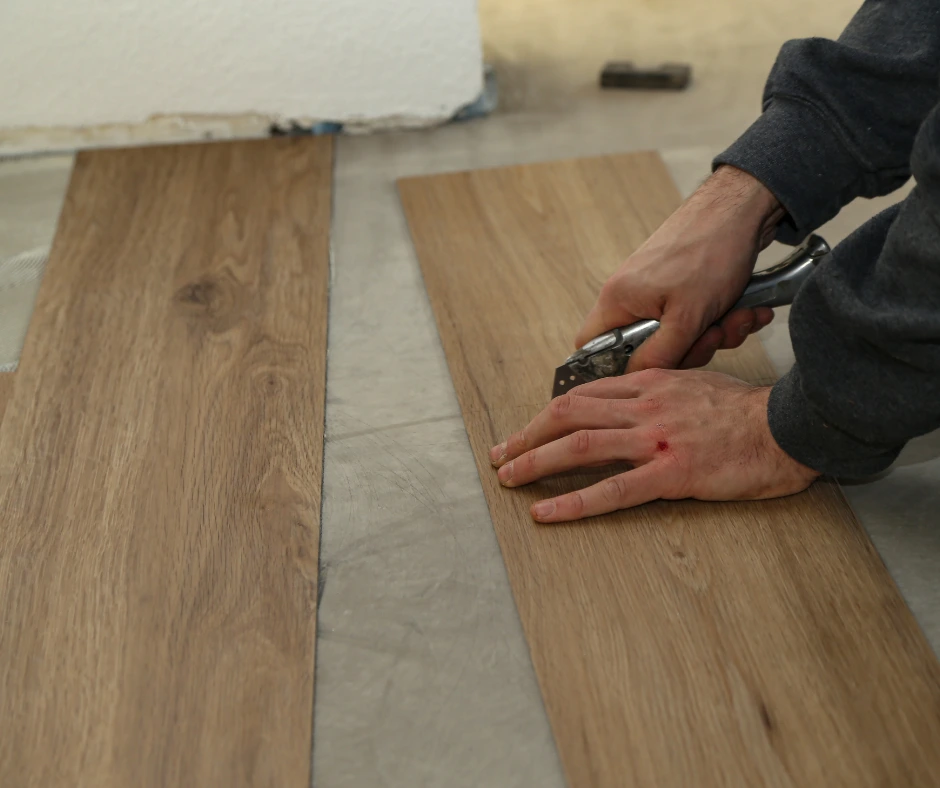
Templating. Rooms are rarely square. We template the room, including door jambs, toilet flanges, and cabinet bases, so the sheet is cut to fit the space you actually have.
Glue-down and seams. The sheet is adhered and rolled so it bonds fully, with no bubbles. Where a seam is unavoidable, it is placed out of the main traffic path and welded or sealed.
Done this way, sheet vinyl lies flat, stays flat, and does not curl at the edges, which is the problem most people remember from older floors.
How to tell a good product apart
Not all sheet vinyl is the same, and the differences are mostly invisible in a showroom photo.
- Wear layer. This is the clear top coat that takes the abuse. Thicker is better, and it is the main thing that separates a floor that lasts from one that looks tired in a few years.
- Backing. A fiberglass-backed sheet lies flatter and is less prone to shrinking than older felt-backed products.
- Brand. We install products from established manufacturers like Mannington, Armstrong, and Tarkett, which stand behind their wear ratings.
Sheet vinyl or LVP?
Both are vinyl and both are waterproof. LVP is thicker, more rigid, feels more like a real wood floor, and hides minor subfloor flaws better. Sheet vinyl is more seamless, usually costs less, and is the stronger choice where water is a regular visitor. If you are also weighing laminate, our laminate vs. LVP comparison covers how those two differ.
Get a straight quote
We bring sheet vinyl samples to every free in-home visit and measure the room on the spot. Learn more about our sheet vinyl flooring installation, or request your free estimate.