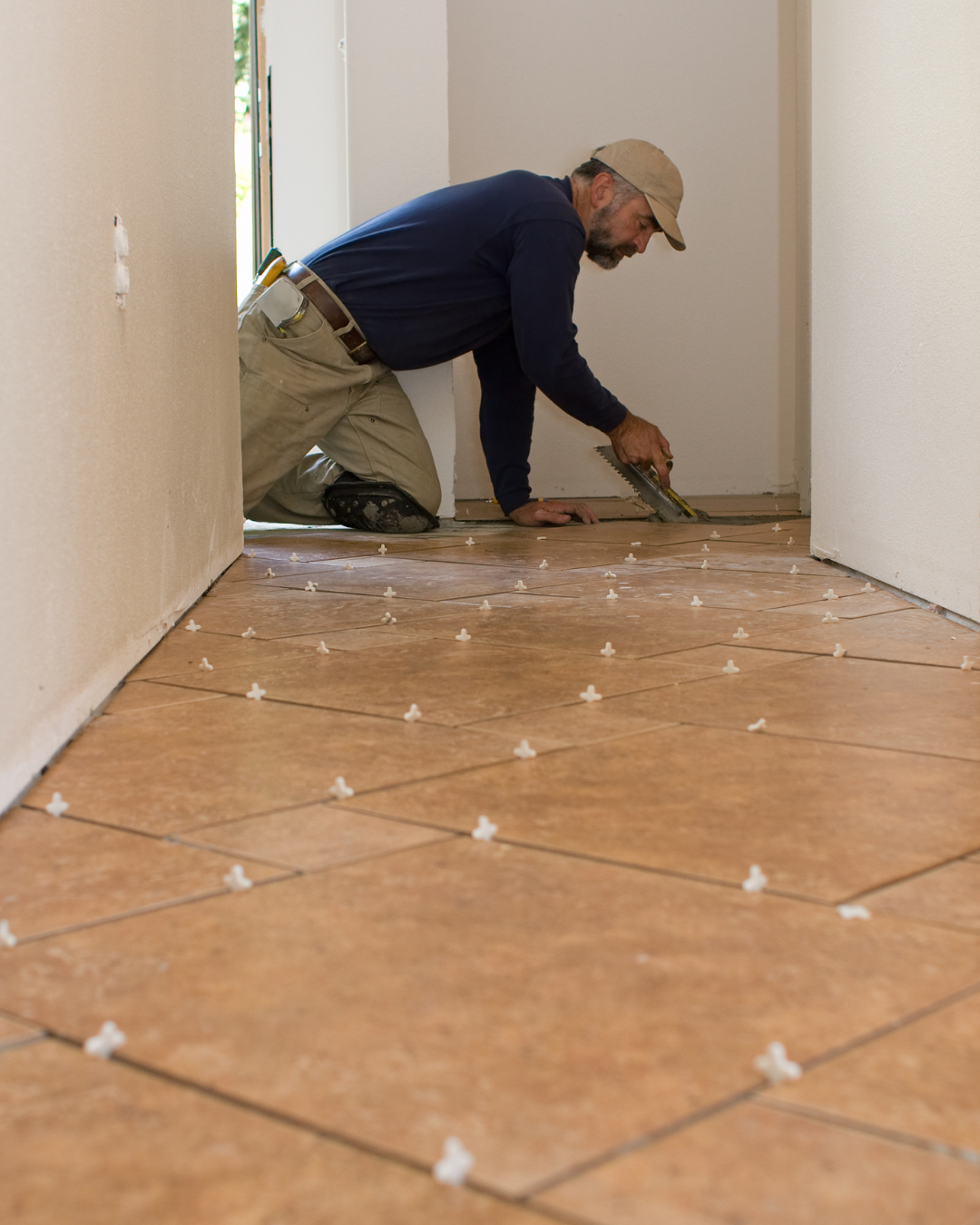
Tile is unusual among trades. The work is largely hidden once it is finished, it is expensive to redo, and the failures show up years later when the person who did it is long gone.
Which means choosing well matters more here than in almost any other part of a renovation. These are the questions we would want a homeowner asking us.
"How are you waterproofing the shower?"
This is the question. In a wet area it separates people who understand tile from people who lay tile.
The answer should name a system and describe how it is detailed at the corners, the curb and the drain, because those junctions are where showers fail. Tile and grout are not waterproof — they are the wearing surface over the membrane that is. Anyone who suggests otherwise, or who talks about water-resistant backer board as though it were waterproofing, has told you what you need to know.
We wrote about the layer itself in what actually makes a shower waterproof.
"What is going between the subfloor and the tile?"
Over a wood subfloor there should be an uncoupling membrane, which lets small substrate movement happen without transferring it into rigid tile. Over a slab with cracking, there should be crack isolation.
A contractor who plans to bond tile directly to whatever is there has not thought about what happens when the substrate moves. In Florida, where humidity swings and slabs are common, that is not a theoretical concern.
"How are you checking the floor is flat?"
The answer should involve a straight edge and a number, not a glance. It matters enormously more with large-format tile, where an unevenness a small tile would absorb becomes visible lippage.
If they are quoting large format without having assessed flatness, they are quoting a floor they have not looked at.
"What grout, and does it need sealing?"
Cementitious grout absorbs and needs sealing periodically. Epoxy does not. Neither answer is wrong, and there is only one wrong response, which is not knowing or not raising it.
In a wet area or a kitchen we would generally recommend epoxy, and a contractor who suggests it unprompted is thinking about how the installation looks in year three rather than on handover day.
"How are the edges finished?"
Where tile ends, the raw edge has to be dealt with — a trim profile, a bullnose tile, or a mitred edge. Each has to be decided and often ordered before the tile arrives.
A quote that does not mention edge treatment is a quote where somebody is going to improvise at the end of the job, and improvised edges are the detail people notice for years.
Things that should worry you
- A quote given over the phone without anyone seeing the space.
- Pressure to decide immediately, or a price that expires today.
- A large deposit requested before any materials are ordered.
- Vagueness about waterproofing, or the phrase "we always do it right" instead of a description.
- A scope that is not written down.
- Only stock photography, no photographs of their own completed work.
None of these prove dishonesty. All of them mean you cannot compare what you are being offered, which comes to the same thing.
Ask to see finished work
Not tile samples — finished installations. Ideally something close to what you are planning, because a contractor who does beautiful floors may not do shower niches often.
Look at the corners in the photographs. Look at where the tile meets the ceiling, the tub, the vanity. The middle of a wall is easy; the junctions are where skill shows.
What we do
We quote in person, name the waterproofing system in writing, list substrate preparation as its own line, and tell you before we start what we expect to find underneath. If a job needs more preparation than a competitor has allowed for, we would rather explain why than win it on a number and raise it later.
Our tile work and shower remodelling pages show what we handle, and a free estimate costs nothing but an hour.